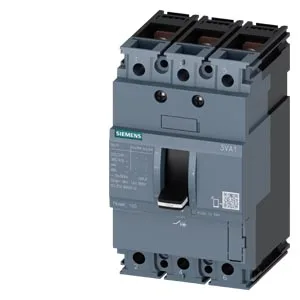
The interrupting capacity of 121 kA at 240 V gives you serious fault-clearing headroom for high-available-fault panels — common in industrial switchboards near large transformers. At 415 V it still breaks 75.6 kA, and at 690 V it holds 11.9 kA, so the same breaker can serve 400 V and 690 V distribution without swapping frames.
Built-in auxiliaries and release — what you get in the frame
The auxiliary switches give status feedback (open/closed) to a controller or HMI; the trip-alarm switch signals a fault trip separately from a manual open. All three are factory-installed, so you don't lose DIN-rail space adding them later. The breaker also carries a voltage-trip indicator and a mechanical trip indicator for quick visual fault identification on the panel face.
The breaker measures 130 mm high, 76.2 mm wide, and 70 mm deep — a standard 3-pole MCCB footprint that fits most DIN-rail or panel-mount enclosures. The 76.2 mm width (3 inches) matches the typical 3-pole MCCB slot in a switchboard; the 70 mm depth leaves room for rear-connected busbars or cable lugs.