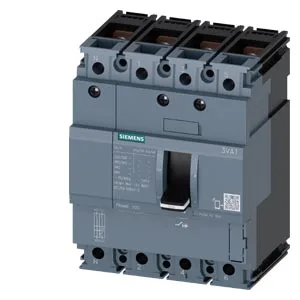
It's a 4-pole unit rated 80 A continuous at 40 °C, with a breaking capacity of 121 kA at 240 V AC — that's the fault current it can safely interrupt without welding contacts or venting plasma. At 415 V AC it still handles 75.6 kA, so it's sized for industrial switchboards where high available fault current is common. Power loss at full load runs 19.2 W — not trivial in a sealed enclosure, so factor that into thermal calculations.
The 80 A rating holds from 40 °C through 50 °C, then derates gently: 78 A at 55 °C, 77 A at 60 °C, 75 A at 65 °C, 74 A at 70 °C. That's a shallow slope — you don't lose much headroom in a warm panel. Breaking capacity drops as voltage climbs: 52.5 kA at 440 V, 11.9 kA at 500 V and stays at 11.9 kA at 690 V. That's typical for an 80 A frame — the arc energy scales with voltage, so the same mechanism can't quench as high a current. For 400 V class systems (415 V nominal), you've got 75.6 kA, which covers most industrial service entrances.
Panel integration and accessories
That's enough for remote tripping and status feedback — common for E-stops or PLC-driven load shedding. No undervoltage release fitted, no ground-fault monitoring module, no communication function. If you need those, the 3VA family supports field-installable accessory kits, but this order code comes bare of those options.