What the interrupting ratings mean for panel coordination
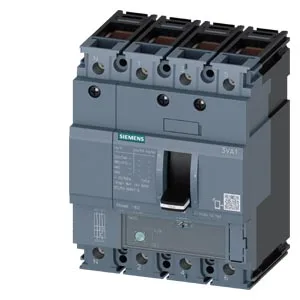
The 3VA1110-3EE46-0AA0: At 240 V the breaker clears 75.6 kA — that's the symmetrical fault current it can interrupt without welding contacts or rupturing the case. At 415 V the figure drops to 52.5 kA, and at 440 V to 32 kA. These are the values you'd use for series-coordination studies with upstream transformers or downstream feeders. The TM220 release provides fixed thermal and magnetic trip settings; no electronic adjustment or communication module is fitted, so this variant is a straightforward line-protection device for panels where selectivity is set by the breaker's own time-current curve rather than a programmable trip unit.
Thermal derating and enclosure fit
The 100 A rating holds up to 50 °C ambient; above that it derates to 98 A at 55 °C, 96 A at 60 °C, 94 A at 65 °C, and 91 A at 70 °C. Max power loss is 25 W. Dimensions are 130 mm high, 101.6 mm wide, 70 mm deep — standard for a 4-pole 100 A frame. Front protection is IP40, so it's suited for enclosed panel mounting where tools or fingers won't reach live parts. Operating range is -25 °C to 70 °C; storage from -40 °C to 80 °C.
