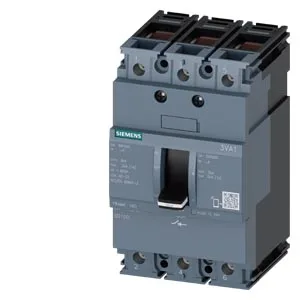
It is built without overload or short-circuit protection — this is a pure isolating and switching device, not a circuit breaker. The unit includes a factory-fitted shunt trip (STL) release rated for 110-127 V DC/AC, so it can be remotely tripped from a control system or emergency-stop circuit. This part sits in the SENTRON 3VA family and is designed to mount in a standard panel or enclosure on a mounting plate; its 70 mm depth and 76.2 mm width make it a compact fit for a 160 A frame. The front-terminal connection means you land the cables on the front face — common in panel layouts where rear access is tight.
Rated continuous current Iu of 125 A is the max current the disconnector can carry continuously without exceeding its temperature rise. That's the number that decides whether this part fits your feeder or branch circuit — size the upstream protection for 125 A or less. Rated insulation voltage Ui is 800 V, so the internal clearances and creepage are designed for 800 V systems; it's rated for AC operation up to 690 V and DC up to 500 V, covering most industrial 400/480 VAC and 500 VDC bus voltages. The shunt trip (STL) release draws its power from the control voltage (110-127 V DC/AC) and is intended for remote or emergency-off tripping. No undervoltage release and no auxiliary contacts are included, so if you need UVR or a status feedback signal, you'll need to add them externally or pick a different variant. The unit can accept an optional motor drive for remote motorized operation. Mechanical endurance is 15,000 operations — that's the rated number of no-load switching cycles before the mechanism may need service. For a switch disconnector used for infrequent isolation (once or twice a shift), that's a long service life. Maximum power loss is 38 W at rated current.