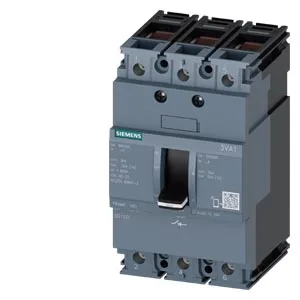
It is a straight disconnect switch with no overcurrent or short-circuit protection built in; the description explicitly states 'without overload protection' and 'without short-circuit protection.' That means it is intended for isolation and switching duty, not for circuit protection. Rated insulation voltage Ui is 800 V, and the maximum operational voltage is 690 V AC (50/60 Hz) or 500 V DC. That covers standard 400 V three-phase panels and most 480 V industrial systems with headroom. The shunt trip release (STL) is wired for 220-250 V DC or 208-277 V AC — a common trip coil voltage range for remote emergency-stop or undervoltage-trip schemes.
The front-terminal connection for the main circuit uses clamp-type terminals, which accept solid or stranded copper conductors.
What the shunt trip and aux contacts mean for your circuit
The shunt trip (STL) is a voltage-triggered release that mechanically trips the switch when voltage is applied to its coil — used for remote emergency-off, undervoltage protection, or interlocking with another device. The coil range (220-250 V DC / 208-277 V AC) is common for industrial control voltages; verify your control circuit matches before wiring. The two auxiliary switches (HQ) are rated for the same voltage class and provide status feedback — one normally-open and one normally-closed contact per switch, giving you two CO pairs total. That is enough to signal 'open' and 'closed' to a PLC and a local indicator without adding an external aux block.