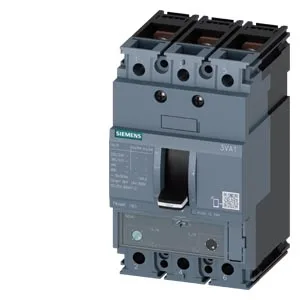
Breaking Capacity — What the Voltage-Specific Ratings Mean for Selectivity
The 3VA1112-3EF32-0AH0: Breaking capacity is stated per voltage level, not as a single number. At 240 V the MCCB interrupts 75.6 kA; at 415 V it handles 52.5 kA; at 440 V it drops to 32 kA; at 690 V it still clears 10.5 kA. For a site electrical engineer working on coordination studies, the 415 V figure is the one that governs most European 400 V distribution — 52.5 kA gives solid headroom above typical 25 kA or 36 kA panel SCCR targets. The 690 V rating matters for industrial grids with 660–690 V motor drives; 10.5 kA is adequate for most downstream sub-distribution but not for high-fault utility tie points.
Built-In Auxiliary Contacts — 2 Aux + 1 Trip Alarm
The auxiliary contacts signal the open/closed position; the trip alarm switch changes state only when the breaker trips on fault, giving a dedicated remote alarm signal. That saves a DIN slot and wiring time compared to a bare MCCB that requires a separate auxiliary module.