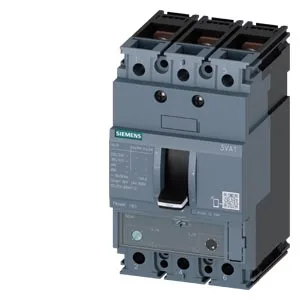
The Siemens SENTRON 3VA1112-3EF32-0DC0 is a 3-pole molded case circuit breaker rated 125 A at 40 °C, with an interrupting capacity of 75.6 kA at 240 V AC. The 125 A rating holds steady from 40 °C up to 50 °C, then derates to 122 A at 55 °C and 114 A at 70 °C — so in a warm panel you lose about 11 A off the top. The 75.6 kA at 240 V tells you this breaker can safely clear a bolted fault up to that level without welding its contacts or rupturing the case; at 415 V the interrupting rating drops to 52.5 kA, and at 690 V to 11.9 kA. That makes it a line-protection device sized for main or large feeder duty in a 240/415 V distribution board. The 70 mm depth and 76.2 mm width match the standard SENTRON 3VA mounting footprint — it clips onto the same DIN-rail adapter or screw-mount base as the rest of the 3VA1 family, so swapping in a panel already laid out for a 3VA frame takes no re-drilling.
Built-in undervoltage release — what it changes for the circuit
The two HQ auxiliary switches give you status feedback (open/closed) back to a PLC or indicator lamp without needing an add-on module.