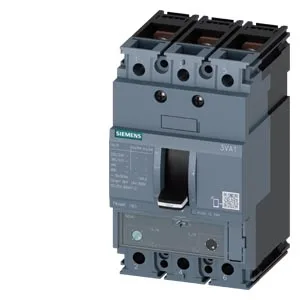
The Siemens SENTRON 3VA1112-3EF32-0KH0 is a 3-pole molded case circuit breaker rated for 125 A continuous current at 40 °C, with a TM240 thermal-magnetic overcurrent release. That 125 A holds flat through 50 °C — only starts to derate at 55 °C (120 A) and drops to 112.5 A by 70 °C, so it's comfortable in a warm panel without oversizing. Interrupting capacity runs 75.6 kA at 240 V, 52.5 kA at 415 V, 32 kA at 440 V, and 10.5 kA at 690 V — enough for most distribution and motor branch circuits where fault current isn't extreme. The shunt trip (STL) release is built in, and the auxiliary contact block gives you 2 aux switches plus a separate trip alarm (HQ).
The 3VA1112-3EF32-0KH0 measures 70 mm deep, 76.2 mm wide, and 130 mm tall — a standard SENTRON 3VA footprint that drops into existing MCCB panel cutouts and DIN-rail adapters. The IP40 front rating means it's fine for indoor switchgear enclosures; no washdown rating here.
What the TM240 release and ratings mean for selection
The TM240 designation means the thermal-magnetic trip unit is fixed at 125 A — no interchangeable rating plug. That's a line-protection breaker, not a motor-protection one (no phase-failure detection, no ground-fault module). The 800 V rated insulation voltage (Ui) covers 480/277 V and 600 V systems with headroom; the interrupting ratings at 415 V and 690 V tell you it can handle industrial supply voltages. No communication function, so if you need remote monitoring, you'd add an external power meter or IO module upstream.