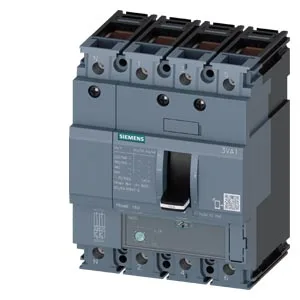
It carries a 125 A rated continuous current (Iu) across the 40 °C to 50 °C band, then derates to 122 A at 55 °C, 120 A at 60 °C, 117 A at 65 °C, and 114 A at 70 °C, so the full 125 A rating holds in most ventilated enclosures but drops if the panel runs hot. At 240 V it interrupts 76 kA; at 415 V it handles 53 kA; at 440 V it drops to 32 kA; at 500 V and 690 V it holds at 11.9 kA. For a 125 A frame these are high-interrupting ratings — the 76 kA at 240 V covers most North American secondary-side faults, while the 53 kA at 415 V suits European industrial distribution where the transformer is close to the panel.
The breaker measures 130 mm high, 101.6 mm wide, and 70 mm deep — a 4-pole frame that fits standard Siemens 3VA panelboard and switchboard mounting patterns. Front IP40 protection means it is splash-proof from the front but not sealed against dust ingress on the sides or rear; install it in a dead-front enclosure or behind a gland plate.
Selectivity and coordination notes
Because the trip settings are not adjustable, selectivity with downstream breakers depends on the natural curve separation: upstream breakers with higher continuous ratings and higher magnetic pickup thresholds will coordinate with smaller branch breakers. The 50% N-conductor protection design means the neutral pole is rated at half the phase current — typical for 4-wire distribution where the neutral carries only unbalanced load, not full phase current. For DC applications the maximum rated operational voltage is 600 V DC; refer to the 3VA device manual for DC switching power values.