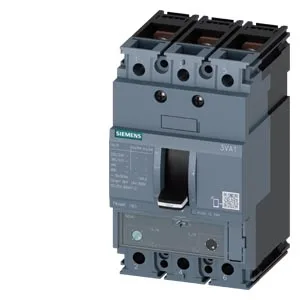
The Siemens SENTRON 3VA1112-4EF32-0HA0 is a 3-pole molded case circuit breaker (MCCB) rated for 125 A continuous current at 40 °C, with no derating needed up to 50 °C — it holds the full 125 A through that range. Above 50 °C it steps down: 120 A at 55 °C, 117.5 A at 60 °C, 115 A at 65 °C, and 112.5 A at 70 °C. That thermal curve means a panel running at 50 °C ambient gets the full nameplate; above that, the breaker self-limits to stay within its insulation temperature class. Breaking capacity is given at four voltages: 121 kA at 240 V, 75.6 kA at 415 V, 52.5 kA at 440 V, and 11.9 kA at 690 V. This is a line-protection variant (not feeder or generator protection), so it is intended for branch-circuit or main-switch duty where the load is a distribution bus or a group of downstream breakers.
No auxiliary contacts are fitted (the auxiliary contact version is listed as "Without"), so if you need remote status or alarm signaling, you will add an external aux switch or a shunt trip (the integrated auxiliary trip is order code 3VA9688-0BL30). This is a plain line-protection MCCB — no Modbus, no phase-failure detection, no integrated metering. For a panel that needs remote trip or status feedback, the shunt trip plus an external PLC digital input covers it.