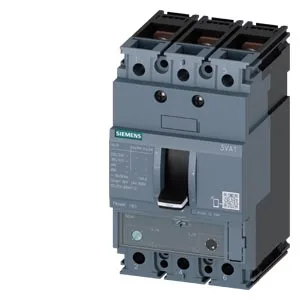
What this MCCB carries — and what it means for your panel
The Siemens SENTRON 3VA1112-4EF32-0KH0 is a 3-pole molded case circuit breaker (MCCB) rated 125 A continuous at 40 °C, with an interrupting capacity of 121 kA at 240 V AC and 75.6 kA at 415 V AC. That interrupting figure at 240 V means it can clear a fault up to 121 kA without the arc re-striking or the case rupturing — critical for high-fault panels downstream of a large transformer or in a distribution board where the available fault current is known to be high. The 125 A continuous rating is the thermal current at 40 °C ambient; derate to 114 A at 70 °C if the breaker sits in a hot enclosure. Rated insulation voltage is 800 V, so it's comfortable on 480 V or 600 V class systems.
Interrupting curve — where the real headroom lives
This breaker's interrupting rating drops as voltage climbs: 121 kA at 240 V, 75.6 kA at 415 V, 52.5 kA at 440 V, and 11.9 kA at 500 V or 690 V. If your panel's available fault current at 480 V is, say, 65 kA, this breaker won't hold — the 52.5 kA at 440 V is the closest published point, and at 480 V the actual rating is lower still. For 480 V applications with high fault current, step up to a higher-rated frame. The 11.9 kA at 500/690 V confirms it's not a 690 V main breaker for high-fault installations.
Panel fit — dimensions and mounting
The 3VA1112-4EF32-0KH0 measures 130 mm high, 76.2 mm wide, and 70 mm deep. That 70 mm depth is the body only — add the handle throw and any auxiliary switch protrusion. Mounts on a DIN rail or panel-mount base; the 76.2 mm width (3 inches) matches the standard SENTRON 3-pole footprint, so it swaps into an existing MCCB slot without busbar rework if the old breaker was the same frame size.
Auxiliary hardware — what's on board and what's not
Factory-fitted with 2 auxiliary switches plus 1 trip alarm switch (HQ configuration), and a shunt trip (STL) for remote tripping. No undervoltage release, no ground-fault monitoring, no communication module. The shunt trip lets a PLC or safety relay cut power on command; the alarm switch signals a trip event back to the control system. If you need undervoltage protection or ground-fault sensing, that's an add-on or a different variant.
Thermal derating — don't cook the trip curve
Rated 125 A from 40 °C through 50 °C, then derates linearly: 122 A at 55 °C, 120 A at 60 °C, 117 A at 65 °C, 114 A at 70 °C. If this breaker sits in a panel that hits 55 °C on a summer afternoon, you lose 3 A of headroom. The maximum power loss is 28.1 W — that's heat that stays inside the enclosure, so factor it into your thermal budget.
