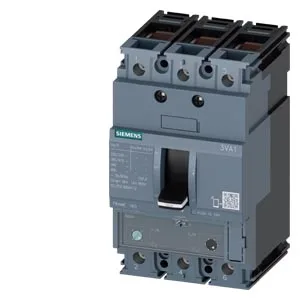
Breaking capacity — what the numbers mean for your fault level
The 3VA1112-4EF36-0DC0: Breaking capacity is the headline spec on any MCCB, and this one delivers 121 kA at 240 V, 75.6 kA at 415 V, 52.5 kA at 440 V, and 11.9 kA at 690 V. The 415 V figure is the one you'll compare against your panel's prospective short-circuit current (PSCC) in a standard 400 V three-phase system. If your fault level at the breaker terminals is under 75.6 kA, this breaker holds. At 690 V the capacity drops to 11.9 kA — still enough for most 690 V industrial networks, but check your transformer impedance if you're close to that limit. The 240 V rating (121 kA) is typical for high-fault residential or light commercial subfeeds.
Thermal derating — the real current you can run
The 125 A rating holds flat from 40 °C to 50 °C ambient. At 55 °C it derates to 120 A, at 60 °C to 117.5 A, at 65 °C to 115 A, and at 70 °C to 112.5 A. If your panel ambient runs above 50 °C — say, a sealed enclosure next to a furnace line — you need to factor that into your wire sizing and load schedule. The breaker itself is rated for operation from -25 °C to 70 °C ambient, and storage from -40 °C to 80 °C. The IP40 front protection means it's not sealed against hose-down, but fine for a clean indoor panel.
Auxiliary contacts and undervoltage release
This breaker ships with 2 auxiliary switches HQ (high-quantity, meaning they're rated for higher electrical endurance in control circuits) and an undervoltage release (UVR). The UVR trips the breaker when the control voltage drops below a threshold — common in safety circuits where loss of control power must open the main contacts. The auxiliary switches can be wired into a PLC input to confirm breaker position. The integrated auxiliary trip order code is 3VA9608-0BB25, which is the factory-fitted accessory; if you're replacing a failed UVR or adding a shunt trip, that's the part number to order separately.
