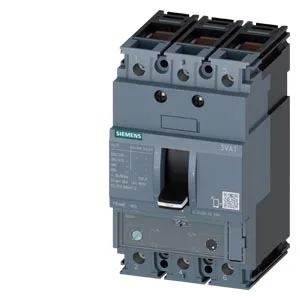
The SENTRON 3VA1112-4EF36-0HH0 is a 3-pole molded case circuit breaker rated 125 A at 40 °C, with a breaking capacity of 121 kA at 240 V and 75.6 kA at 415 V. The current derating curve is published from 40 °C through 70 °C: holds 125 A up to 50 °C, then drops to 122 A at 55 °C, 120 A at 60 °C, 117 A at 65 °C, and 114 A at 70 °C. If your enclosure runs hot, that derating table is the one you size against — the 125 A nameplate number only applies below 50 °C.
Width is 76.2 mm (3 in), depth 70 mm (2.76 in), height 130 mm (5.12 in). That 76.2 mm width is a standard 3-module DIN-rail footprint — it clips onto the rail and occupies three 25.4 mm slots. Maximum power loss is 28.1 W. In a sealed enclosure, that heat needs to be factored into the thermal budget — especially if the breaker is running near its 125 A limit in a high-ambient panel.
The basic switch supplied inside this breaker is 3VA11124EF360AA0 — that's the internal mechanism. If you're doing a warranty swap or a field repair on the switch core, that's the sub-part number to reference.
Breaking capacities at other voltages: 52.5 kA at 440 V, 11.9 kA at 500 V, and 11.9 kA at 690 V. The drop above 440 V is steep — at 500 V and 690 V it's the same 11.9 kA, which tells you the internal arc-quenching design hits its limit above 440 V. If your system fault current at 480 V exceeds 11.9 kA, this breaker is not the right pick for that bus.