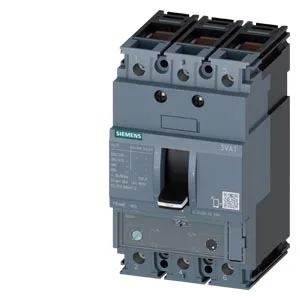
The 3VA1112-5EF36-0CA0: Rated 125 A continuous at 40 °C ambient, with minimal derating up to 70 °C (114 A at 70 °C). That gives you headroom in a warm enclosure — the breaker doesn't force a derating step until you cross 55 °C. The interrupting capacity is the headline: 187 kA at 240 V, 121 kA at 415 V, 75.6 kA at 440 V, and 17 kA at 500/690 V.
If your enclosure runs hotter — say 60 °C — you can still pull 120 A through it. That's a practical advantage for a panel with multiple breakers stacked together. Footprint is 70 mm deep × 76.2 mm wide × 130 mm tall — standard 3VA1 panel cutout. If you're swapping from an earlier 3VA1 variant (like the 3VA1110-5ED36-0AC0, a lower-current or lower-breaking-capacity version), the mounting hole pattern and bus-bar spacing are identical, so it drops in without re-drilling. The difference is in the trip rating and interrupting capacity, not the mechanical interface.