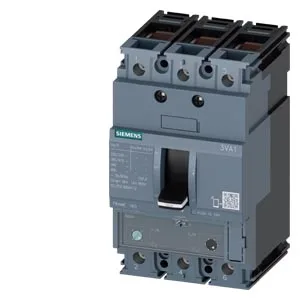
It's a line-protection device — meaning it's sized to protect cables and busbars, not motor loads, so don't try to hang a motor starter off it without checking the coordination study.
This MCCB delivers 187 kA at 240 V, 121 kA at 415 V, 75.6 kA at 440 V, and 17 kA at 690 V. That's a high-interrupting-capacity (HIC) class breaker; you'd spec it at the main distribution point where fault currents are highest, not downstream where 25–50 kA is usually enough. The 690 V figure of 17 kA is still respectable for a 125 A frame — some competitors drop to single digits at that voltage.
Thermal derating — the real continuous current depends on your panel temp
At 55 °C it's 120 A, at 60 °C it's 117.5 A, at 65 °C it's 115 A, and at 70 °C it's 112.5 A. If your panel runs at 55 °C (common in sealed, sun-exposed enclosures), you still get 120 A out of it.
Width is 76.2 mm, depth is 70 mm, height is 130 mm. That width — roughly 3 inches — is standard for a 125 A frame in the SENTRON 3VA platform. It's a screw-mount breaker, not a plug-in; you'll need busbar or cable connections.
Auxiliary releases and accessories
Comes with an undervoltage release (UVR) — part of the design, not an add-on. That means if control voltage drops, the breaker trips. The integrated auxiliary trip is order code 3VA9608-0BB25 — if you need to replace just that module, that's the part number to order separately. No voltage trigger, no communication function, no phase failure detection, no ground fault monitoring. This is a basic line-protection MCCB with UVR and aux contacts — nothing fancy, but reliable for the job.