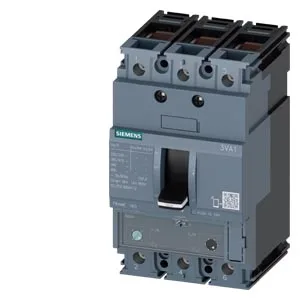
The Siemens SENTRON 3VA1112-6EF36-0JA0 is a 3-pole molded case circuit breaker (MCCB) rated 125 A at 40 °C, with a TM240 thermal-magnetic overcurrent release and an integrated shunt trip (STL) auxiliary release.
Breaking capacity steps down with voltage: 220 kA at 240 V, 154 kA at 415 V, 75.6 kA at 440 V, and 17 kA at both 500 V and 690 V. That 17 kA at 690 V is the figure to check if the breaker lands in a 690 V distribution section — it's adequate for most industrial 690 V panelboards but not for high-fault 690 V buswork. The TM240 release holds 125 A flat from 40 °C through 50 °C, then derates to 122 A at 55 °C, 120 A at 60 °C, 117 A at 65 °C, and 114 A at 70 °C. For a panel running at 55 °C ambient, the usable rating drops to 122 A — plan the load accordingly.
Shunt trip and line-protection design
At 70 mm deep, 76.2 mm wide, and 130 mm tall, this 3-pole MCCB fits standard Siemens 3VA mounting accessories and busbar systems. Max power loss of 28.1 W means the breaker dissipates heat into the enclosure — account for it in the panel thermal budget, especially if multiple breakers are ganged.