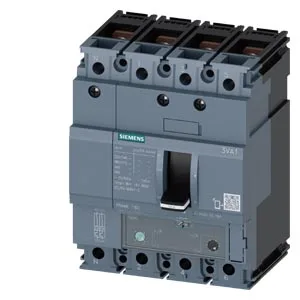
What this MCCB does — and the rating that decides the fit
Its interrupting capacity is the headline number: 220 kA at 240 VAC, 154 kA at 415 VAC, and 76 kA at 440 VAC. The 125 A rating holds flat from 40 °C to 50 °C (125 A), then derates to 122 A at 55 °C, 120 A at 60 °C, 117 A at 65 °C, and 114 A at 70 °C. In a warm panel — say 55 °C ambient — you lose 3 A of headroom, so size the load circuit accordingly.
Panel integration — footprint and mounting
Dimensions: 101.6 mm wide, 130 mm high, 70 mm deep. The 101.6 mm width (4 inches) is the standard 4-pole MCCB footprint — it occupies four 25 mm module slots on a DIN rail or bolts directly to a mounting plate.
Maximum DC operational voltage is 600 V, making it usable in DC bus or battery circuits up to that level. The TM240 release provides thermal (overload) and magnetic (short-circuit) protection; the 50% N-conductor protection setting means the neutral pole trips at half the phase current, typical for 4-wire systems with harmonic loads. Power loss is 28.1 W maximum — account for that in enclosure thermal calculations, especially when grouping multiple breakers. Endurance is rated at 20,000 cycles (mechanical/electrical latching). That is a maintenance interval, not a lifetime limit — plan inspection and contact replacement around that count for high-cycle applications like frequent motor starting. No communication module is fitted, and no ground-fault monitoring version. This is a plain thermal-magnetic breaker — no remote trip indication or earth-leakage sensing. If those are needed, look to the 3VA1 with electronic releases or the 3VA2 series with communication.