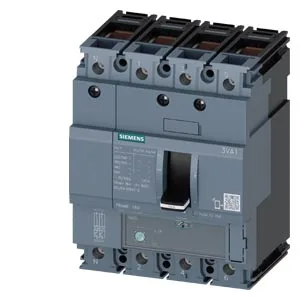
What this MCCB delivers on the line
The Siemens SENTRON 3VA1112-6GE46-0AA0 is a 4-pole molded case circuit breaker rated 125 A continuous, with a TM220 thermal-magnetic release. It's a line-protection device — no communication module, no ground-fault monitoring — built for straightforward overcurrent and short-circuit protection in distribution panels. Breaking capacity is the headline here: 220 kA at 240 V AC, 154 kA at 415 V, 75.6 kA at 440 V, and 17 kA at both 500 V and 690 V. That 220 kA figure at 240 V means this breaker handles high-fault points like a transformer secondary or a large bus riser without cascading upstream — it's sized for the high-end of industrial SCCR requirements. Thermal derating is gradual: holds 125 A up to 50 °C, then drops to 122 A at 55 °C, 120 A at 60 °C, 117 A at 65 °C, and 114 A at 70 °C. If your panel ambient runs hot, that 114 A at 70 °C is the number to design around — not the 125 A nameplate. Mounts in a standard distribution panel footprint: 70 mm deep, 101.6 mm wide, 130 mm tall. The IP40 front protection means it's fine for indoor panel use but not washdown zones.
Lifecycle and sourcing posture
Maximum power loss is 28.1 W — factor that into your panel thermal budget if you're stacking several breakers in a confined enclosure. Rated insulation voltage is 800 V; max DC operational voltage is 600 V. The adjustable li max (short-circuit release) goes to 1250 A. The TM220 release is fixed thermal, adjustable magnetic — typical for general-purpose feeder protection.
Integration and wiring notes
Optional motor drive available (product extension) for remote trip or reset — order separately if you need that. No communication function onboard, so no Modbus or PROFIBUS integration without an external module. Storage range is -40 °C to 80 °C; operating range is -25 °C to 70 °C. The storage limit governs handling and warehousing, not running conditions. N-conductor protection is 100% — the neutral pole is fully rated, not reduced. That matters for 4-wire systems where the neutral carries phase imbalance current.
