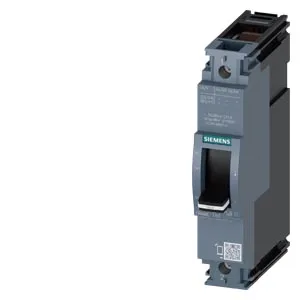
What the 70 kA breaking capacity means on site
The 3VA1112-6MH36-0DA0 is a 3VA1 IEC frame 160 MCCB with class H breaking capacity — Icu=70kA at 415V AC. On a 415V panel with a transformer large enough to push 70 kA into a bolted fault, this breaker clears it before the arc flash escalates. Short-circuit coordination upstream stays intact because the breaker's let-through energy stays within the upstream device's withstand curve. This is a 3-pole unit, rated In=125A continuous. The TM120M thermal-magnetic trip gives motor-start protection: the thermal element tracks overload heating, and the magnetic element handles short circuits. Note the description says 'without overload protection' — that means the thermal element is sized for motor starting duty, not for protecting the cable. The overload relay in the starter handles running overcurrent; this breaker provides short-circuit backup and isolation.
Undervoltage release and adjustable short-circuit pickup
The built-in undervoltage release (UVR) trips the breaker when supply voltage drops below the dropout threshold, nominal 208-230V AC 50/60Hz. This is common on motor branch circuits where you want the starter to drop out on brownout and not reclose automatically when power returns. It's not a shunt trip — the UVR holds the mechanism closed only when coil voltage is present, so a loss of control power opens the breaker mechanically. The short-circuit release Ii is adjustable from 5 to 15 times In (625A to 1875A at 125A In). That range lets you coordinate with downstream motor starters and contactors: set it low enough to clear a bolted fault fast, high enough to ride through motor inrush without nuisance trips. Clamp terminals accept copper or aluminium conductors up to the frame's rated cross-section — no lug kit needed for most panel builds.