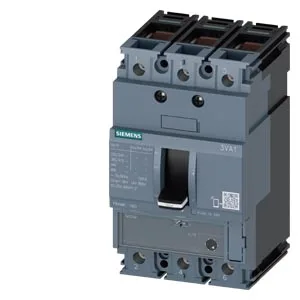
The Siemens SENTRON 3VA1112-6MH36-0KC0 is a 3-pole molded case circuit breaker (MCCB) rated 125 A continuous at 40 °C, with a breaking capacity of 220 kA at 240 V AC — that's the short-circuit current it can safely interrupt without welding or rupturing, sized for high-fault service-entrance or distribution panels where upstream transformer capacity is large. The 70 mm depth and 76.2 mm width fit a standard 3-pole MCCB footprint on a DIN rail or panel-mount base; the 130 mm height leaves room for the auxiliary switch block and shunt trip (STL) that ship with this variant.
The breaker holds 125 A from 40 °C up through 50 °C (–). Above that it derates: 122 A at 55 °C, 120 A at 60 °C, 117 A at 65 °C, and 114 A at 70 °C (–). If your panel ambient runs over 50 °C, you lose about 3 A per 5 °C rise — plan the load accordingly.
Breaking capacity across voltage taps
The interrupting rating drops as system voltage rises: 220 kA at 240 V, 154 kA at 415 V, 75.6 kA at 440 V, and 7.5 kA at both 500 V and 690 V. On a 480 V or 600 V class panel, the 75.6 kA at 440 V is the relevant figure for most North American 480Y/277 V systems; at 690 V the 7.5 kA limit means this breaker is not a high-fault device on 690 V — verify the available fault current at that voltage before specifying.
Rated insulation voltage is 800 V, and the operating temperature range spans -25 °C to +70 °C, with storage from -40 °C to +80 °C.