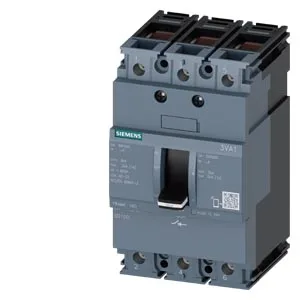
It is a pure disconnect — no overload or short-circuit protection elements onboard, which means it serves as a manual isolating point in a distribution circuit where upstream protection is already coordinated. Rated insulation voltage Ui is 800 V, with maximum operational voltage at 690 V AC 50/60 Hz and 500 V DC. The short-time withstand rating is 2 kA limited to 1 s (and also 2 kA at 0.5 s), which tells you the disconnector can hold closed under fault current for that duration while an upstream breaker clears — provided the prospective fault current at the panel does not exceed that figure.
The disconnector measures 70 mm deep, 76.2 mm wide, and 130 mm tall — the 3VA1 frame 160 footprint shared across the SENTRON 3VA family. Front terminals for the main circuit, clamp-type connection, so it accepts copper or aluminium conductors up to the frame rating without lug adaptors. The optional motor drive (product extension noted as available) means the disconnector can be remote-operated for automated load shedding or emergency stop sequences, though the base unit is manual.
Why the UVR matters for your circuit
Unlike a shunt trip (which requires a deliberate voltage pulse to trip), the UVR holds the disconnector closed only as long as the control voltage is present. If your safety circuit expects a drop-out on power loss, this is the correct release type. The UVR does not carry a leading contact, so it cannot signal its own state ahead of the main contacts — factor that into your auxiliary contact planning if feedback is required.