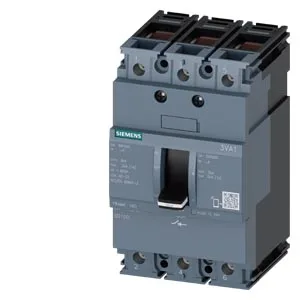
The Siemens 3VA1116-1AA36-0JC0 is a SENTRON 3VA1 switch disconnector in an MCCB-style molded case, rated for 160 A continuous current without overload or short-circuit protection elements — it is a pure disconnecting means, not a circuit breaker. It ships with a factory-installed shunt trip (STL) release rated 110-127 V DC/AC 50/60 Hz and two HQ auxiliary switches, making it a load-break switch for isolation and emergency-off circuits where remote tripping is required. The 3-pole design handles AC loads up to 690 V or DC loads up to 500 V, with an insulation voltage rating of 800 V.
Continuous Current and Thermal Derating
The 160 A rating holds flat from 40 °C through 50 °C, then derates progressively: 158 A at 55 °C, 155 A at 60 °C, 153 A at 65 °C, and 150 A at 70 °C. For a panel running at 50 °C ambient, you get the full 160 A without any headroom loss. Above that, the derating curve is linear enough to calculate intermediate points.
The 3VA1116-1AA36-0JC0 measures 130 mm high, 76.2 mm wide, and 70 mm deep. It uses front terminal connections for the main circuit — clamp-type terminals accepting copper or aluminum conductors. Mechanical service life is 15,000 operating cycles typical.
Auxiliary and Control Wiring
Two CO contacts (form C) are provided by the HQ auxiliary switches. The shunt trip coil draws its control power from a separate 110-127 V DC or AC source — it does not share the main circuit supply. If motor-drive operation is needed later, the product extension for an optional motor drive is supported.
Power Loss and Thermal Budget
Maximum power loss is 38 W at rated current. For a panel thermal budget, that is the figure to use when sizing ventilation or calculating temperature rise inside the enclosure. The loss is resistive (I²R) and scales with the square of the load current.