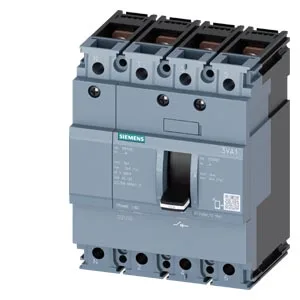
It sits in the 3VA1 IEC frame-160 family and is designed for load switching and isolation — not overcurrent protection. Rated insulation voltage is 800 V, and it handles up to 690 V AC 50/60 Hz or 600 V DC across the poles. Short-time withstand is 2 kA for 1 s and also 2 kA for 0.5 s — enough to ride through a fault while upstream protection clears, but not a high-break device itself.
Where you'd use it
This is a panel-mounted disconnect for a distribution or motor feeder circuit where you need local isolation with remote trip capability. The shunt trip lets you drop the load from a PLC or emergency-stop circuit. Main circuit connection is via busbar — front terminals — so it's designed to bolt into a SENTRON distribution panel or a custom busbar assembly. No auxiliary contacts are fitted (0 CO contacts), so if you need status feedback, you'll add an external aux switch or monitor the shunt trip circuit.
It's not a breaking current — as a switch disconnector, it's rated to make and break load currents, but not fault currents. The 2 kA short-time withstand (1 s and 0.5 s) tells you it can survive a fault of that magnitude while the upstream breaker clears, but you must coordinate with the protective device upstream. Power loss is 38 W maximum at rated current — that's the heat it dumps into the enclosure. For a panel with multiple disconnectors, sum the losses to size ventilation or derating. The shunt trip coil draws its own power from the control circuit; the 38 W figure is the main contact dissipation.