What the interrupting ratings mean for your panel
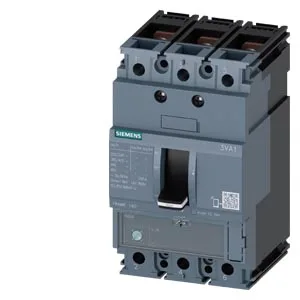
The Siemens SENTRON 3VA1116-5EE32-0AF0 is a 3-pole molded case circuit breaker rated for line protection, carrying 160 A continuous current (Iu) at up to 50 °C without derating. The interrupting capacity steps down with system voltage: 187 kA at 240 V, 121 kA at 415 V, 75.6 kA at 440 V, and 17 kA at 690 V. That 187 kA figure at 240 V means this breaker can safely clear a fault at the full available short-circuit current of a large transformer-fed distribution board — no need for a current-limiting fuse upstream in most North American 240 V panels. At 415 V, the 121 kA rating covers high-capacity industrial feeds where the transformer impedance alone doesn't limit the fault. The 17 kA at 690 V is still substantial for a 160 A frame; it handles most motor control center bus faults at that voltage level.
Thermal derating and the TM220 release
The TM220 overcurrent release is a thermal-magnetic design — the thermal element handles overloads, the magnetic element handles short-circuits. The breaker holds its full 160 A rating from 40 °C through 50 °C. Above that, derating is gradual: 153.6 A at 55 °C, 150.4 A at 60 °C, 147.2 A at 65 °C, and 144 A at 70 °C. If your panel ambient runs at 60 °C, you lose about 6% of the continuous rating — still within the margin for most 150 A feeder designs. The 800 V rated insulation voltage (Ui) means the internal clearances and creepage are sized for 690 V line-to-line systems, so it's comfortable on 480 V and 600 V class supplies.
Panel fit and auxiliary contacts
The 3VA1116-5EE32-0AF0 measures 130 mm high, 76.2 mm wide, and 70 mm deep. The 76.2 mm width is a standard 3-pole MCCB footprint — it occupies three 25.4 mm (1-inch) module positions on a DIN rail or panel-mount base. The IP40 front protection means the breaker face is sealed against tools and small wires, but the enclosure around it needs to handle the rest of the environment. It ships with one auxiliary switch and one trip alarm switch (HQ type) integrated — that gives you a Form-C contact for status feedback and a separate contact that changes state only when the breaker trips on fault, not on manual switching. No undervoltage release, no shunt trip, no communication module on this variant.
Endurance and mechanical life
The latching endurance is rated at 15,000 operations. That's the number of mechanical on-off cycles the mechanism is designed to survive under normal conditions. For a main feeder breaker that cycles once or twice a day, that's roughly 20 years of service. For a breaker that sees frequent switching — say, as a disconnect for a machine that cycles every hour — the endurance becomes a planning factor. The trip indicator gives a visual flag when the breaker has tripped on fault, which speeds troubleshooting on a multi-breaker panel.
