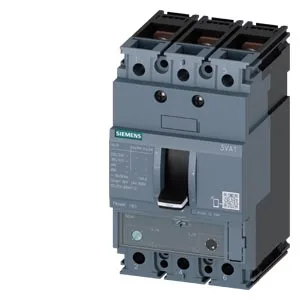
The 160 A rating holds flat through 50 °C — at 55 °C it derates to 153.6 A, and at 70 °C it reaches 144 A, so the thermal curve matters if the breaker sits near other heat sources in a sealed enclosure. Breaking capacity is 220 kA at 240 V, 154 kA at 415 V, 75.6 kA at 440 V, and 17 kA at 690 V — these are the fault-clearing limits the breaker can interrupt without welding its contacts or rupturing the case. For a 415 V distribution board, 154 kA SCCR gives substantial headroom over typical utility fault levels.
The 3VA1116-6EF32-0BA0 is a 3-pole MCCB with a 76.2 mm width (roughly 3 inches), 130 mm height, and 70 mm depth — it fits standard panel-mount cutouts for SENTRON 3VA frames. It carries an IP40 rating on the front, so it is suitable for indoor distribution boards where no washdown or dust ingress is expected. The overcurrent release is the TM240 thermal-magnetic type, and the integrated auxiliary trip is order code 3VA9608-0BB11 if you need to add a shunt trip or UVR later.
Delta: how this compares to the 3VA1112-5EF32-0CA0
The closest functional sibling in the SENTRON 3VA family is the 3VA1112-5EF32-0CA0. The key delta is the rated current: the 3VA1116-6EF32-0BA0 is a 160 A frame, while the 3VA1112-5EF32-0CA0 is a 125 A frame. Both are 3-pole line-protection breakers with TM releases, but the 160 A version carries higher interrupting ratings at every voltage point. The physical footprint (width, height, depth) is identical between the two frames, so a panel cutout designed for the 125 A unit will accept the 160 A unit without rewiring or re-punching — form, fit, and function are preserved at the mounting level. The trade-off is that the 160 A unit is heavier and the thermal derating curve starts at a higher base current, so for a 125 A load the 160 A breaker runs cooler and offers more headroom for future load growth.