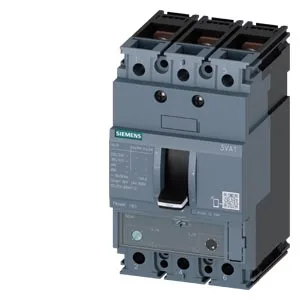
160 A continuous, 220 kA interrupting — what that means for your panel
The Siemens 3VA1116-6EF32-0HA0 is a SENTRON molded case circuit breaker rated for 160 A continuous at 40 °C, with a maximum interrupting capacity of 220 kA at 240 V AC. That 220 kA rating means it can safely clear a fault at that level without the arc flashing upstream — critical for high-fault installations like transformer secondaries or large motor control centers. The 3-pole design covers three-phase loads, and the TM240 thermal-magnetic trip unit gives fixed overload and short-circuit protection curves suited to feeder or main breaker duty. It carries a shunt trip release (STL) for remote emergency-off or undervoltage tripping — you energize the shunt trip coil to open the breaker on command. No undervoltage release or ground-fault monitoring is fitted as standard, so if either is needed, plan for an accessory add-on. The breaker is designed for line protection, meaning it guards the cable or bus downstream rather than a specific motor or device.
Thermal derating — the real current you get above 40 °C
The 160 A rating holds steady up to 50 °C. Above that, it derates linearly: 158 A at 55 °C, 155 A at 60 °C, 153 A at 65 °C, and 150 A at 70 °C. If your panel ambient runs hot — say, a sealed enclosure near a furnace line — size the breaker for the derated figure, not the 40 °C nameplate. The maximum operating ambient is 70 °C, with a storage range of -40 °C to 80 °C.
Breaking capacity across voltages — not just the 240 V headline
The interrupting rating drops as system voltage rises: 154 kA at 415 V, 75.6 kA at 440 V, and 17 kA at both 500 V and 690 V. If you're specifying for a 690 V industrial network, the 17 kA figure is the one that governs — not the 220 kA headline. The rated insulation voltage is 800 V, so the breaker is physically insulated for that level even if the interrupting rating is lower at higher voltages.
Panel fit — DIN-rail dimensions and mounting
The breaker measures 130 mm high, 76.2 mm wide (3 inches — a standard MCCB footprint), and 70 mm deep. That 70 mm depth is the body only; add clearance for the shunt trip wiring and any arc-chamber venting above and below. It snaps onto a DIN rail or mounts with screws through the base. The 3-pole width matches standard busbar spacing for panelboard or switchboard layouts.