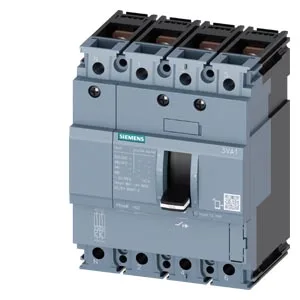
160 A frame, 4-pole — what the ratings mean for fit
The Siemens 3VA1116-6GD42-0AA0 is a SENTRON molded case circuit breaker (MCCB) on a 160 A frame, configured as a 4-pole unit with a TM210 thermal-magnetic overcurrent release. The 160 A rating holds continuously at 40 °C ambient and derates to 150 A at 70 °C, per the thermal curve. That 10 A drop across a 30 °C rise is typical for a TM release — if the panel ambient runs hot, size the upstream conductor for the derated value, not the nameplate. Interrupting capacity is the headline number that governs fault coordination. At 240 V this breaker clears 220 kA; at 415 V it's 154 kA; at 440 V it drops to 75.6 kA; at 500 V and 690 V it holds at 17 kA. That 220 kA figure at 240 V is well above typical utility fault levels in North American 240/120 V split-phase or 240 V delta services — it gives headroom for high-fault locations like substation secondaries. The 154 kA at 415 V covers most European 400 V industrial grids with room to spare. The 17 kA at 690 V is the limiting case for 690 V wind or marine installations; verify the available fault current at the point of installation against that ceiling.
Integration — panel fit and mounting
The 3VA1116-6GD42-0AA0 measures 130 mm high, 101.6 mm wide, and 70 mm deep. The 4-pole width of 101.6 mm (4 inches) is the standard 4-pole MCCB footprint for this frame class — it occupies four 25.4 mm (1-inch) module positions on a DIN rail or panel-mount plate. The 70 mm depth leaves clearance for rear-mounted busbars or a gland plate; verify the enclosure depth against that dimension plus wiring space. Front-face protection is IP40, so the breaker is protected against tools and wires larger than 1 mm, but not sealed against dust ingress — suitable for a clean indoor panel. Power loss at rated current is 38 W maximum. For a 4-pole breaker in a sealed enclosure, that 38 W contributes to the internal temperature rise. If the panel is densely packed, account for this in the thermal budget — the derating curve above 40 °C already reflects self-heating, but adjacent devices may need additional ventilation or a larger enclosure.
