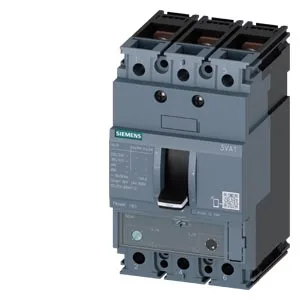
Siemens SENTRON 3VA1120-5EF32-0AG0 — 20 A MCCB, Line Protection, Current Production
The Siemens SENTRON 3VA1120-5EF32-0AG0 is a 3-pole molded case circuit breaker (MCCB) rated for line protection duty, carrying a continuous current Iu of 20 A and a rated insulation voltage Ui of 800 V. Its breaking capacity scales with system voltage: 187 kA at 240 V AC, 121 kA at 415 V, 75.6 kA at 440 V, and 17 kA at 690 V — figures that give ample headroom for most industrial distribution panels where fault currents are high but well-characterized. The TM240 thermal-magnetic overcurrent release is fixed-trip, so no field adjustment of the magnetic pickup; the thermal element holds full 20 A up to 50 °C ambient, then derates to 18 A at 70 °C. That thermal curve matters if this breaker sits in a non-ventilated enclosure near other heat sources — plan your fill factor accordingly.
Physical Fit & Panel Integration
The breaker measures 76.2 mm wide, 130 mm high, and 70 mm deep. That width is a standard 3-pole MCCB footprint — it occupies three 25.4 mm (1-inch) module positions on a DIN rail or panel-mount base. The front face carries an IP40 protection class, meaning it's protected against tools and wires >1 mm but not against water ingress; keep it inside a rated enclosure. The auxiliary contact configuration is 1 auxiliary switch plus 1 trip alarm switch (HP type), which gives one N/O + N/C signal for status feedback and a separate alarm contact that changes state only on a trip event — useful for remote annunciation without wiring through the main breaker position.
Breaking Capacity — What the Ratings Mean for Coordination
The 187 kA at 240 V is the highest interrupting rating on this nameplate, typical for a high-capacity MCCB in a low-voltage service entrance or large distribution board where the utility transformer can deliver massive fault current. At 415 V the rating drops to 121 kA, still well above what most secondary switchgear sees. The 17 kA at 690 V is the limiting case — if your system runs 690 V (common in mining or marine installations), verify that the available fault current at that voltage stays under 17 kA, or step up to a higher-frame breaker. The trip indicator is present, so after a fault you get a visual red flag on the front — no need to meter the load side to confirm it tripped.
