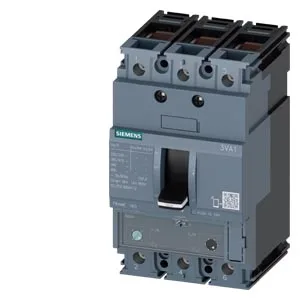
What this MCCB carries and what it means for your panel
The Siemens SENTRON 3VA1120-5EF36-0KC0 is a 3-pole molded case circuit breaker rated for 20 A continuous current with a TM240 thermal-magnetic release. The interrupting capacity is 187 kA at 240 V, 121 kA at 415 V, 75.6 kA at 440 V, and 17 kA at 690 V — these are the fault-clearing ratings that determine whether this breaker coordinates with upstream gear and safely interrupts a short circuit without rupturing the enclosure. At 240 V, 187 kA puts it in the high-interrupting tier for a 20 A frame; at 690 V the 17 kA figure is the binding limit for three-phase 690 V distribution. The breaker carries a shunt trip (STL) auxiliary release (order code 3VA9688-0BL33 for the integrated auxiliary trip) and two HQ auxiliary switches. There is no undervoltage release, no ground-fault monitoring, no communication module, and no phase-failure detection — this is a straightforward line-protection device, not a power-monitoring or remote-trip platform. The front face is rated IP40, so it is protected against tools and wires larger than 1 mm but not against water ingress; mount it inside a panel, not exposed to washdown. The TM240 release is a thermal-magnetic design — the thermal element handles overload protection (inverse-time curve), and the magnetic element handles short-circuit instantaneous trip. Rated continuous current holds at 20 A up to 50 °C ambient; above that it derates linearly to 18 A at 70 °C. If your panel ambient runs above 50 °C, size the breaker for the derated value, not the nameplate 20 A.
Dimensions and panel fit
The breaker measures 70 mm deep, 76.2 mm wide, and 130 mm tall. The 76.2 mm width is a standard 3-pole MCCB footprint.
Selectivity and coordination note
The 187 kA at 240 V and 121 kA at 415 V are the SCCR values that govern selectivity with upstream breakers or fuses. For a 20 A MCCB, these are high enough to coordinate with a 200 A or 400 A upstream SENTRON 3VA frame in most industrial distributions — the ratio of interrupting capacities gives the upstream breaker time to clear before the downstream device reaches its let-through. At 690 V the 17 kA limit is lower; if your fault current at 690 V exceeds that, you need a current-limiting upstream device or a higher-rated frame.
