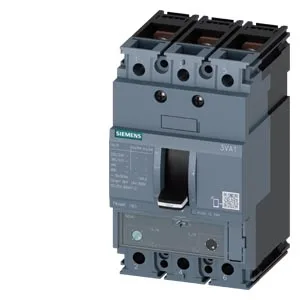
What it is and what the ratings mean for your panel
The Siemens SENTRON 3VA1120-5EF32-0KH0 is a 3-pole molded case circuit breaker (MCCB) rated for line-protection duty. It carries a rated continuous current Iu of 20 A, and the TM240 thermal-magnetic release handles overloads and short circuits up to that continuous rating. The interrupting capacity tells you where it can safely clear a fault: 187 kA at 240 V, 121 kA at 415 V, 75.6 kA at 440 V, and 17 kA at 690 V — that's the kind of muscle you need on a high-fault panelboard or a motor control center feed, not a branch breaker. The shunt trip (STL) auxiliary release lets you trip it remotely via a control signal, which is handy for emergency-stop circuits or interlocking schemes.
Thermal derating — the number that actually governs your load in a warm cabinet
The 20 A rating holds flat from 40 °C up to 50 °C, so in a typical ventilated panel it carries its nameplate current without a second thought. At 55 °C it steps down to 19.2 A, then 18.8 A at 60 °C, 18.4 A at 65 °C, and 18 A at 70 °C. If your enclosure runs hot — say, next to a drive or near a steam line — that 18 A at 70 °C is the number you size the load to, not the 20 A sticker. The operating temperature range is -25 °C to 70 °C, and storage spans -40 °C to 80 °C, so it handles cold warehouses and hot shipping containers without drama.
Auxiliary contacts and trip accessories
It ships with 2 auxiliary switches plus 1 trip alarm switch (HQ designation) — that gives you status feedback for a PLC input, a remote annunciator, or a safety circuit. The integrated auxiliary trip is order code 3VA9688-0BL33, which is the shunt trip coil you wire to your control voltage. There is no undervoltage release, no ground-fault monitoring, no communication module, and no phase-failure detection on this variant; it's a straightforward thermal-magnetic breaker with remote trip capability. The front face carries IP40 protection, so it's fine inside a closed panel but not meant for washdown areas.
