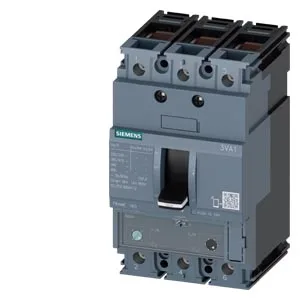
The Siemens SENTRON 3VA1120-6EF36-0BH0 is a 3-pole molded case circuit breaker (MCCB) rated for line protection, with a continuous current rating of 20 A that holds across ambient temperatures from 40 °C up to 50 °C before it starts to derate — at 55 °C it's still 19.2 A, and it drops to 18 A by 70 °C. That thermal curve matters if you're stuffing this into a warm panel; the rating doesn't fall off a cliff at 40 °C like some older frames do. The interrupting capacity is the headline here: 220 kA at 240 V, 154 kA at 415 V, 121 kA at 440 V, and still 17 kA at 690 V. Those numbers mean this breaker can sit upstream of a large transformer or a high-fault panelboard and still clear a bolted fault without welding its contacts shut. The auxiliary contact block is a 2-auxiliary-switch plus 1-trip-alarm-switch HQ configuration, which gives you two form-C signals for status feedback and a dedicated alarm contact that only changes state on a trip event — handy for a PLC input that logs faults separately from run status.
The 3VA1120-6EF36-0BH0 measures 76.2 mm wide by 130 mm tall by 70 mm deep. That 76.2 mm width is a standard 3-pole MCCB footprint — three modules at 25.4 mm each — so it drops into a panel that was laid out for a 3-pole SENTRON frame without needing to shift DIN rail or re-drill mounting holes.
For sourcing: we quote this to order against an RFQ. If you're comparing it against the 3VA1112-5EF32-0CA0, the main difference is the frame size and the release — the 3VA1112 is a 125 A frame with an electronic release, while this is a 20 A frame with a thermal-magnetic TM240. They're not footprint-compatible; the 3VA1120 is the smaller frame.