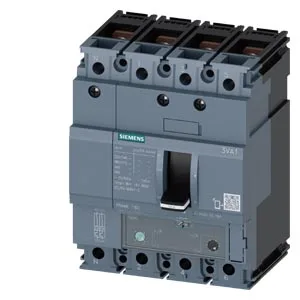
The Siemens SENTRON 3VA1125-3GF42-0AA0 is a 4-pole molded case circuit breaker rated for line protection, with a TM240 thermal-magnetic trip unit and a continuous current rating of 25 A across the full 40–50 °C ambient range. Interrupting capacity is voltage-dependent: 75.6 kA at 240 V, 52.5 kA at 415 V, 32 kA at 440 V, 11.9 kA at 500 V and 690 V — so the available fault current at the panel bus determines whether this breaker clears without upstream coordination. The TM240 trip unit means thermal protection follows a 240 A frame curve; at 25 A continuous, the thermal element is sized to carry rated load without nuisance tripping while the magnetic instantaneous element handles short-circuit events. Thermal derating is minimal through 50 °C (full 25 A), then drops to 24 A at 55–60 °C and 23 A at 65–70 °C — useful to check if the breaker sits near other heat sources in a crowded enclosure.
Dimensions are 130 mm height, 101.6 mm width, 70 mm depth — the 4-pole width is the key fit check for existing Siemens 3VA panel cutouts or DIN-rail adapter plates. Front-side protection is IP40, meaning tools or fingers won't contact live parts from the front; the back and sides rely on enclosure protection, so this breaker is intended for a closed panel or distribution board.