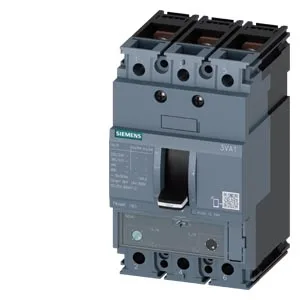
The Siemens SENTRON 3VA1125-5EF32-0DC0 is a 3-pole molded case circuit breaker (MCCB) rated for 25 A continuous current, with a massive 187 kA interrupting capacity at 240 V — that's the kind of headroom you spec when the fault current on the secondary side of a big transformer is ugly, or when you need to coordinate downstream breakers without cascading failure.
This MCCB holds its full 25 A rating from 40 °C up to 50 °C ambient, then derates gently — 24 A at 55 °C, 23 A at 70 °C. That means in a sealed, hot panel near a motor drive or transformer, you don't lose much capacity. Breaking capacity drops as line voltage climbs: 121 kA at 415 V, 75.6 kA at 440 V, still 17 kA at 500 V and 690 V. For a 400 V industrial panel, 121 kA SCCR covers most transformer-fed busways.
Built-in release and auxiliaries
It also carries two HQ auxiliary switches for remote status indication, so the PLC sees the breaker state without an add-on module. If you're using it to protect a motor branch, the inrush may nuisance-trip unless you oversize or switch to a motor-protective breaker.