What the ratings mean for fit
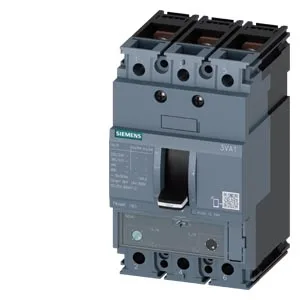
The Siemens 3VA1125-4EF32-0CH0 is a SENTRON molded case circuit breaker (MCCB) sized for line protection in distribution panels. Its 25 A rated continuous current (Iu) holds flat from 40 °C to 50 °C, then derates gradually to 22.5 A at 70 °C — so in a warm enclosure the breaker still carries the full 25 A up to 50 °C, which covers most North American and European panel ambient conditions without a derate step. The TM240 thermal-magnetic release handles overload and short-circuit protection in one package; the undervoltage release (UVR) lets a safety circuit or emergency-stop chain trip the breaker remotely, which is useful for PSM-clean lockout schemes in ammonia refrigeration rooms where you want a hard disconnect on loss of control voltage. Breaking capacity is the headline number for this class: 121 kA at 240 V, 75.6 kA at 415 V, 52.5 kA at 440 V, and 11.9 kA at 690 V. Those figures tell you the breaker can safely interrupt a fault up to those current levels without welding contacts or rupturing the case. At 415 V — common in European industrial panels — 75.6 kA SCCR means it sits comfortably downstream of a transformer or main breaker with a high available fault current. The 690 V rating (11.9 kA) is lower but still covers most motor-circuit fault levels at that voltage. The 3-pole design with an auxiliary contact block (2 auxiliary switches + 1 trip alarm switch HQ) gives you status feedback to a PLC or remote I/O — the trip alarm signals a fault condition, the aux switches mirror the breaker position. The front IP40 rating keeps dust out of the enclosure face; the breaker itself is designed for DIN-rail or panel-mount integration in a standard distribution board.
Panel integration and deployment
Dimensions: 70 mm deep, 76.2 mm wide, 130 mm high. That width (76.2 mm) is a standard 3-pole MCCB footprint — it drops into a panel cutout or DIN-rail adapter sized for the SENTRON 3VA family without extra spacing. The 70 mm depth leaves room for wiring behind the breaker in a 200 mm deep enclosure. The undervoltage release coil needs a control voltage; verify polarity and suppression per the panel wiring diagram before energizing.
