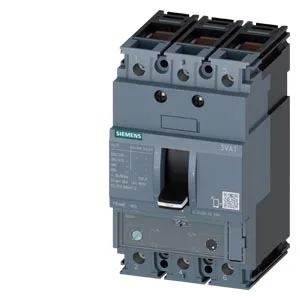
The Siemens SENTRON 3VA1132-4EF36-0KH0 is a 3-pole molded case circuit breaker (MCCB) rated for line protection, carrying a continuous current Iu of 32 A that holds flat from 40 °C through 50 °C — no derating needed in a typical warm panel — then tapers to 28.8 A at 70 °C. Its TM240 thermal-magnetic release handles the overload and short-circuit curve; the shunt trip (STL) lets a remote signal or emergency-stop chain drop the breaker independently of the bimetal. Breaking capacity is the headline: 121 kA at 240 V, 75.6 kA at 415 V, 52.5 kA at 440 V, and 11.9 kA at 690 V. The 690 V rating is lower but still covers most motor-circuit fault levels at that voltage.
Dimensions are 76.2 mm wide, 130 mm tall, 70 mm deep — a standard 3-pole MCCB footprint that fits SENTRON distribution blocks and most DIN-rail or screw-mount panel layouts. The 70 mm depth leaves clearance for rear-connected busbars or cable ducts behind the breaker. Latching endurance is rated at 15 000 operations, which covers years of manual switching in a panel that sees weekly isolation. That covers unheated warehouses and outdoor enclosures in temperate climates. The integrated auxiliary trip is a separate order code (3VA9688-0BL33) — verify it matches your panel's shunt-trip voltage before wiring.