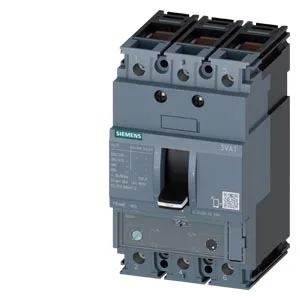
What it is and what it does
The Siemens SENTRON 3VA1140-4EF36-0AD0 is a 3-pole molded case circuit breaker (MCCB) designed for line protection — meaning it sits at the incoming feeder or main distribution point in a panel, protecting cables and busbars against overload and short circuit. It carries a continuous current rating of 40 A at 40 °C ambient, and the TM240 thermal-magnetic release provides fixed overload and short-circuit trip curves tuned for cable and busbar protection rather than motor starting. The interrupting capacity is what sets this breaker apart: 121 kA at 240 V AC, 75.6 kA at 415 V, 52.5 kA at 440 V, and 11.9 kA at both 500 V and 690 V. That means it can safely clear a bolted fault up to those levels without rupturing or welding contacts — critical for high-fault installations like transformer secondaries or large motor control centers where upstream fault current can exceed 50 kA. Rated insulation voltage is 800 V, so the breaker can be applied on 690 V systems without derating the internal creepage distances. The 70 mm depth and 76.2 mm width (3-inch footprint) fit standard Siemens SENTRON panel mounting patterns — a direct swap into existing 3VA1-series cutouts.
Installation and integration
The breaker mounts on a DIN rail or directly to a panel backplate via the SENTRON mounting base. The 3-pole design occupies a 76.2 mm width — three standard 25.4 mm pole spaces — so it fits standard Siemens SENTRON distribution boards and panelboards without adapters. It ships with a TM240 thermal-magnetic release, which is non-interchangeable in the field — the trip unit is fixed. If you need adjustable thermal or magnetic settings, look at the 3VA2 series with electronic releases. The auxiliary switch block is configured as 3 auxiliary switches HQ (high-qualified), which can be wired for remote status indication or trip alarm. Power loss at rated current is 10.8 W maximum — negligible for enclosure thermal calculations in most panels, but worth noting if the breaker is tightly grouped in a sealed enclosure above 40 °C ambient. The temperature derating curve shows full 40 A up to 50 °C, then drops to 39 A at 55 °C and 38 A at 65 °C, so derating is minimal in typical 40 °C switchrooms.
