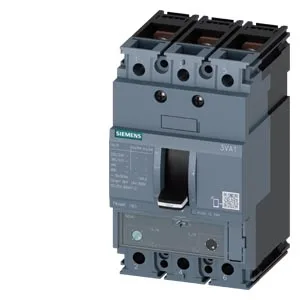
Its 40 A continuous current Iu holds flat from 40 °C through 50 °C, then derates to 36 A at 70 °C, so in a warm cement plant control room or a packed switchboard you still get the full 40 A unless ambient pushes past 50 °C. Breaking capacity is the headline: 187 kA at 240 V, 121 kA at 415 V, 75.6 kA at 440 V, and 17 kA at 690 V. IP40 on the front keeps dust out of the mechanism; the rest of the body is open to the enclosure, so mount it in a clean, dry panel. Dimensions are 70 mm deep, 76.2 mm wide, 130 mm tall — standard 3VA frame footprint that drops into a SENTRON distribution board or a DIN-rail adapter plate.
At 55 °C it drops to 38.4 A, at 60 °C to 37.6 A, at 65 °C to 36.8 A, and at 70 °C to 36 A. That's a shallow curve: you lose only 4 A over a 20 °C rise above 50 °C. In a sealed enclosure with multiple breakers radiating heat, this MCCB won't nuisance-trip as long as the actual load stays under the derated value for the ambient.
What it doesn't carry — and why that matters for specification
No trip indicator, no voltage trigger, no undervoltage release, no communication function, no phase failure detection, no ground fault monitoring, and no other measurement function. This is a bare-bones line-protection MCCB: it trips on overcurrent and short circuit only. If your application needs remote tripping, ground-fault alarm, or power monitoring, you need a different 3VA variant with the appropriate accessory or electronic trip unit. The 3VA1140-5EF32-0AD0 is for straightforward feeder protection where the only requirement is clearing faults and carrying the load.