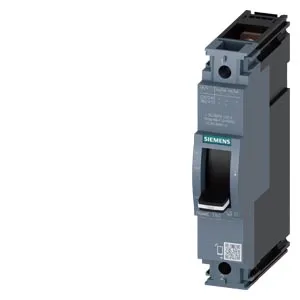
Line protection MCCB — 50 A, 1-pole, 76 kA interrupting at 240 V
It carries a rated continuous current Iu of 50 A and delivers a 76 kA interrupting capacity at 240 V AC — that figure drops to 9 kA at 415 V, so the available fault current at the panel's service voltage governs the selection. The TM210 thermal-magnetic release is fixed at 50 A Ir (adjustable response value current Ir max. 50 A) with a magnetic trip Ii fixed at 500 A (both min. and max.). This is a single-pole unit, so it breaks one phase; for multi-phase circuits you stack matching poles or step to a 2- or 3-pole variant.
Sizing and thermal derating — what the 50 A rating means in a real panel
At 55 °C it drops to 49 A, at 60 °C to 48 A, at 65 °C to 46 A, and at 70 °C to 45 A. The TM210 release is thermal-magnetic, so the thermal element tracks the ambient curve; the magnetic element (Ii = 500 A fixed) handles short-circuit protection. Rated insulation voltage Ui is 500 V, and maximum rated operational voltage with DC is 125 V — this breaker can serve DC branch circuits within that limit.
Physical fit — DIN-rail footprint and panel integration
The 3VA1150-4ED12-0AA0 occupies a 25.4 mm (1 in) wide slot on the DIN rail — standard single-module width for a 1-pole MCCB. Depth is 70 mm (2.8 in), height 130 mm (5.1 in). No motor drive option is fitted (Product extension / optional / motor drive: No), so remote trip or reset requires an external actuator.