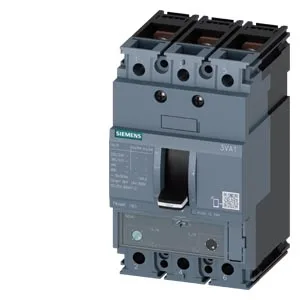
The Siemens SENTRON 3VA1150-4EF32-0KC0 is a 3-pole molded case circuit breaker (MCCB) rated for 50 A continuous current at 40 °C, with a TM240 thermal-magnetic overcurrent release and an integrated shunt trip (STL) auxiliary release. It's a line-protection device — meaning it's set up for feeder and distribution duty, not motor branch-circuit protection. The 70 mm depth, 76.2 mm width, and 130 mm height footprint fits standard SENTRON 3VA panel cutouts and bus-bar layouts. The IP40 front protection means it's fine inside a closed enclosure — not for washdown areas.
This MCCB delivers 121 kA at 240 V, 75.6 kA at 415 V, 52.5 kA at 440 V, and 11.9 kA at 690 V. Those are the interrupting ratings (Icu) at each voltage level — the fault current it can safely clear without welding or rupturing. For a 480 V panel fed from a 100 kA transformer, the 52.5 kA at 440 V tells you this breaker has headroom for most common fault levels at that voltage.
Current derating — the real-world continuous current
At 55 °C it drops to 48 A, at 60 °C to 47 A, at 65 °C to 46 A, and at 70 °C to 45 A.
Auxiliary contacts and shunt trip
The breaker comes with 2 auxiliary switches (HQ type) for status feedback — open/closed indication to a PLC or remote monitoring system. The shunt trip (STL) allows remote tripping via a control voltage, useful for emergency-stop circuits or supervisory shutdown.