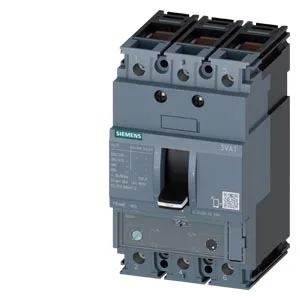
It carries a 50 A continuous rating across the 40 °C to 50 °C ambient band, with a slight derating curve above that: 49 A at 55 °C, 48 A at 60 °C, 46 A at 65 °C, and 45 A at 70 °C. Breaking capacity is the headline spec here. At 240 VAC this MCCB interrupts 121 kA; at 415 VAC it handles 75.6 kA; at 440 VAC it's 52.5 kA; and at 500 V and 690 V it holds at 11.9 kA. That 121 kA figure at 240 V puts it squarely in the high-fault category for North American 120/240 V split-phase or 240 V delta services — useful downstream of a large transformer or near a utility service entrance where available fault current is high.
Auxiliary configuration and panel integration
The trip alarm switch signals the breaker's thermal-magnetic trip state back to a control system — useful for remote fault annunciation without adding a separate monitor relay. The 70 mm depth means it clears shallow enclosures; verify the enclosure depth plus wiring bending radius before committing the layout.
Environmental and operating limits
The storage minimum of -40 °C matters for cold warehouse or unheated site storage before installation. The operating maximum of 70 °C aligns with the derating curve top end — at 70 °C the breaker is still rated for 45 A, so it can run in a hot panel without immediate nuisance tripping as long as the load is below that derated value.