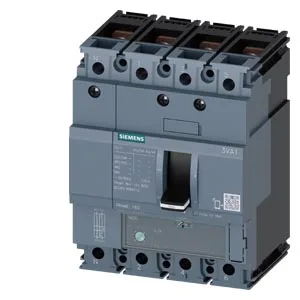
What this 50 A MCCB delivers on a mill floor
Four poles give you the isolation and overcurrent protection a three-phase line needs plus a switched neutral — common on European-sourced panels where a solid neutral isn't assumed. The TM220 release gives a fixed thermal pickup and magnetic trip that's factory-set; no field-adjustable dials, so what you order is what protects the feeder.
At 40 °C the breaker carries a full 50 A. That holds steady through 50 °C; at 55 °C it derates to 49 A, and at 70 °C it's 45 A. If the panel sits near a dryer section or a hot motor control center, the 45 A floor at 70 °C still gives you headroom for a 40 A continuous load. The 14.6 W maximum power loss means the heat it dumps into the enclosure is modest — a standard steel enclosure with passive ventilation handles it, but if you're stacking several breakers in a tight row, check the cumulative dissipation against the enclosure's rating.
Selectivity and coordination
For selectivity studies, the TM220's magnetic trip is fixed, so you coordinate by choosing a downstream breaker with a lower magnetic threshold. The 800 V rated insulation voltage gives you the dielectric margin for 690 V systems, but the actual breaking capacity at 690 V drops to 17 kA — that's still adequate for most 690 V motor branch circuits, not for a main tie.