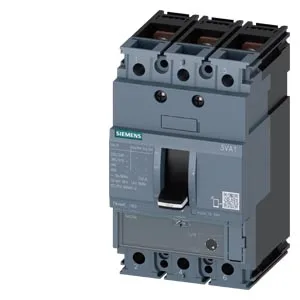
What this MCCB is and where it lands in the panel
The Siemens 3VA1150-5MH32-0AA0 is a SENTRON molded case circuit breaker (MCCB) configured as a starter protection device — meaning it's built to sit ahead of a motor starter or a group of motor loads, combining overcurrent and short-circuit protection in one 3-pole frame. Rated 50 A continuous at 40 °C (derates to 45 A at 70 °C), it uses a TM120M thermal-magnetic release that handles the inrush without nuisance tripping on motor start. The interrupting capacity at 240 V is 187 kA, which gives enough headroom for high-fault panels near transformers or large drives. At 415 V it still holds 121 kA, so it's not a breaker that needs an upstream current-limiting fuse in most industrial distributions. The 70 mm depth and 76.2 mm width mean it fits standard 3-pole MCCB slots on the DIN rail or panel-mount plate — no special adapter needed.
Thermal derating and what it means for a hot control room
This breaker holds its full 50 A rating up to 50 °C ambient. At 55 °C it drops to 49 A, at 60 °C to 48 A, and at 70 °C to 45 A. That thermal curve is what matters when the MCC is in a cement plant or steel mill control room where summer temps push past 45 °C. The maximum operating temperature is 70 °C, storage range is -40 °C to 80 °C — so it survives the roof of a hot warehouse or a shipping container in summer. Power loss at full load is 14.6 W, which is manageable for a 3-pole frame; you don't need forced ventilation for a single unit, but cluster several in a tight enclosure and the heat adds up.
What the ratings mean for selectivity and coordination
The interrupting ratings across voltages tell you where this breaker can be placed in a selective coordination study. At 240 V it clears 187 kA, at 415 V it clears 121 kA, at 440 V it clears 75.6 kA, and at 500 V and 690 V it clears 7.5 kA. That steep drop above 440 V means you need to verify the available fault current at the point of installation if the system voltage is above 480 V. The insulation voltage rating is 800 V, so the breaker itself is rated for the higher voltage bus — the limitation is the interrupting capacity, not the dielectric withstand. The TM120M release is a fixed thermal-magnetic type; no electronic trip unit adjustments, no communication module, no undervoltage release or phase failure detection on this variant. It's a straightforward, no-frills motor-circuit protector that does one job and does it without extra wiring.
Physical fit and panel integration
Dimensions: 130 mm height, 76.2 mm width, 70 mm depth. The width is a standard 3-inch (76.2 mm) footprint for a 3-pole MCCB — matches the cutout spacing on most panelboards and MCC buckets. Depth of 70 mm (2.76 in) leaves enough room for rear-connected bus bars or cable lugs without forcing an oversized enclosure. Front protection is IP40, meaning it's sealed against tools and wires but not against dust ingress; if the panel is in a dusty environment (cement plant, grain handling), the enclosure itself needs to provide the IP rating, not the breaker face. No trip indicator on the front — you'll know it's tripped by the handle position or by checking the load side with a meter.
