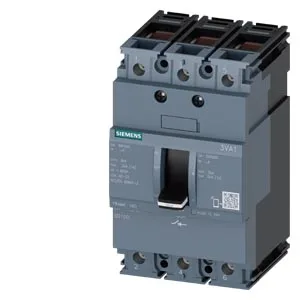
This SENTRON 3VA1163-1AA36-0JH0 is a 3-pole switch disconnector in the 3VA1 IEC frame 160 family — built in an MCCB form factor but intentionally without overload or short-circuit protection. That's unusual for a molded-case-style device; most MCCBs start shedding current at 40 °C. Here it holds flat. The shunt trip (STL) release is rated for 110-127 V DC and AC 50/60 Hz, so it'll drop the disconnect on a remote signal from an E-stop or safety relay.
Where It Goes in a Panel
This is a front-terminal clamp connection, so you land the main circuit conductors on the front face — no rear-connect bus bar required. The dimensions are 70 mm deep, 76.2 mm wide (that's 3 inches exactly), and 130 mm tall. That's not trivial — if you're packing several of these in a small enclosure, you'll want to account for the heat rise. Mechanical service life is 15,000 operating cycles typical, so it's built for frequent switching in a disconnect role, not just infrequent isolation.
If your panel runs hot near a motor drive or a furnace wall, this disconnect won't force you to oversize the frame just to hold rating. The insulation voltage is rated 800 V, operating voltage 690 V AC and 500 V DC, so it covers 480 V and 600 V class systems with margin. The shunt trip is the main reason you'd pick this variant over a plain disconnect. It's a 110-127 V coil, so it works on common control voltages in North America (120 V) and Europe (110 V) without a transformer tap. No undervoltage release on this unit — if you need UVR, that's a different order code.