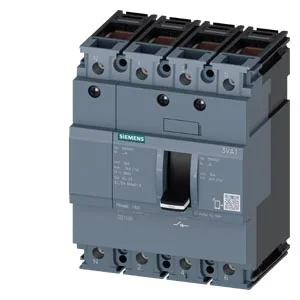
The Siemens 3VA1163-1AA46-0AC0 is a 4-pole switch disconnector from the 3VA1 series, built on the IEC frame 160 platform. It's rated at 63 A continuous current and carries no integrated overload or short-circuit protection — it's a straight disconnect, intended for isolation and switching duty where the upstream protection is handled by a separate device. The SD100 designation tells you it's a standard-duty disconnector, not a motor-rated switch. Two HQ auxiliary switches are factory-fitted, giving you status feedback without adding a separate aux block on the DIN rail.
Where it lives in the panel
The 4-pole form factor means it occupies the width of four single-pole breaker spaces — plan your fill factor accordingly. The clamp connection (screw-clamp, not spring-cage) is field-friendly: strip 12–14 mm, torque to the value on the nameplate, and you're done. No special tools beyond a screwdriver. The auxiliary switches are wired to the front terminals, so you can land your PLC input wires without reaching behind the disconnector. If you're replacing a fused disconnect in an existing panel, verify the DIN-rail spacing — the 3VA1 frame 160 is a compact footprint but the aux switches add a few mm of depth above the main body.
The headline number is 63 A, but the important detail is what it's not: this disconnector has no overload or short-circuit protection built in. That means it's sized for a circuit where the upstream breaker or fuse provides the protection — typically a feeder disconnect, a panel main switch, or an isolator for a fixed-load group. If you need integrated motor protection (overload relay and short-circuit trip), you'd look at the 3VA2 motor-protective circuit breaker family instead. The 4-pole version handles three-phase plus neutral, so it's suited for TN-S or TN-C-S systems where you need to switch the neutral as well.