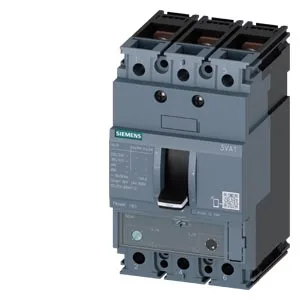
It carries a 63 A continuous rating at 40 °C and holds that same 63 A all the way up to 50 °C, then starts a gentle derate: 62 A at 55 °C, 61 A at 60 °C, 60 A at 65 °C, and 58 A at 70 °C (–). So in a warm panel that sees 60 °C inside, you still get 61 A of headroom — not a hard cliff. The overcurrent release is a TM240 thermal-magnetic type, meaning it uses a bimetal for overload protection and a solenoid for short-circuit, fixed at a 240 A magnetic trip threshold. That's a standard choice for feeder applications where you want thermal memory and a predictable instantaneous pickup.
Breaking capacity — what it can interrupt
This breaker's interrupting rating changes with system voltage, which matters when you're tying it into an existing bus. At 240 V it's rated 75.6 kA; at 415 V it's 52.5 kA; at 440 V it drops to 32 kA; and at 500 V or 690 V it holds at 11.9 kA. If your available fault current at the panelboard is 65 kA at 240 V, this breaker covers it; if you're on a 480 V system with 25 kA available, the 32 kA at 440 V rating covers that too.