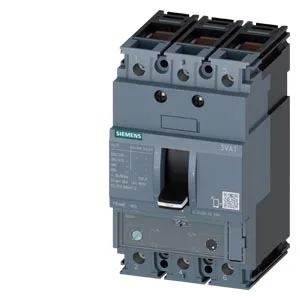
What this MCCB delivers on the line
The Siemens 3VA1163-4EF36-0AB0 is a SENTRON molded case circuit breaker (MCCB) rated for 63 A continuous at 40 °C, with a TM240 thermal-magnetic release that handles overload and short-circuit protection in a single device. The 121 kA breaking capacity at 240 V means it can safely interrupt high-fault currents without cascading upstream — a key spec for panel builders coordinating selectivity downstream of a transformer or main switch. Rated insulation voltage is 800 V, and the breaker carries its full 63 A rating through 50 °C ambient, then derates to 60 A at 65 °C and 58 A at 70 °C. That thermal curve matters when the breaker sits in a crowded enclosure with other heat sources — the 17.3 W maximum power loss is the heat it dumps into the panel. This is a line-protection design (not motor-protection), so the TM240 release is calibrated for feeder and distribution circuits. The 3-pole configuration fits three-phase systems, and the breaker accepts the 2 auxiliary switches HP for status feedback to a PLC or SCADA.
Breaking capacity across voltages
The interrupting rating drops as system voltage rises: 121 kA at 240 V, 75.6 kA at 415 V, 52.5 kA at 440 V, and 11.9 kA at both 500 V and 690 V. For a 480 V panel (common in North America), the 52.5 kA at 440 V is the closest published figure — expect the actual rating at 480 V to sit between the 440 V and 500 V values. The 690 V rating of 11.9 kA confirms this breaker can serve 600 V class systems with adequate fault-current headroom for most industrial distributions.
Panel integration and dimensions
The breaker measures 130 mm high, 76.2 mm wide, and 70 mm deep — a compact footprint for a 63 A MCCB. It mounts on a DIN rail or directly to a backplate via the SENTRON mounting accessories. The 3-pole width (76.2 mm) matches the standard 3-module spacing for Siemens SENTRON enclosures, so it slots into a pre-bussed panel without re-drilling. Operating temperature range is -25 °C to 70 °C, with storage from -40 °C to 80 °C. That covers most indoor industrial environments, including unheated warehouses and roofed outdoor substations.
