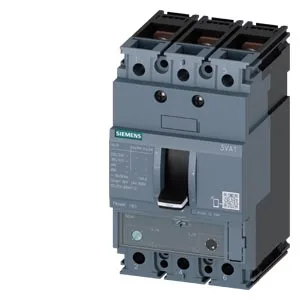
Its 63 A rated continuous current holds at ambient temperatures up to 50 °C before any derating kicks in — at 55 °C it still carries 60.48 A, and at 70 °C it's 56.7 A, so you can push it into a warm enclosure without losing much headroom. The interrupting ratings are what make this part a serious choice for high-fault locations: 187 kA at 240 V, 121 kA at 415 V, 75.6 kA at 440 V, and 17 kA at 690 V. Three poles, a TM240 thermal-magnetic release (adjustable time delay tr max 1 s), and a built-in trip indicator. Rated insulation voltage Ui 800 V, operational range -25 °C to 70 °C, storage from -40 °C to 80 °C.
Lifecycle and sourcing — current production, no obsolescence concern
For a maintenance-spares buyer, this is a part you can hold as a critical spare with confidence — it's not going to vanish mid-year. The 15 000-cycle mechanical endurance (latching) is typical for a 63 A frame; it's not a high-cycle motor-switching device, but it's fine for infrequent breaker operations in a distribution role.
Integration — what fits, what doesn't
If you need remote trip or status beyond the aux/alarm contacts, you'll add external relays or a separate monitoring device.