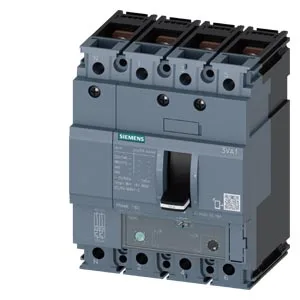
It's built for line protection in distribution panels where high fault current capacity is the deciding spec — 187 kA at 240 V AC, dropping to 121 kA at 415 V, then 75.6 kA at 440 V, and 17 kA at 500 V and 690 V. The TM240 release means the thermal element is calibrated for a 240 A frame — the breaker's continuous rating is set by the installed trip unit, here 63 A. That gives you a 63 A MCCB on a 240 A frame, which means the interrupting capacity is frame-limited, not trip-limited.
At 55 °C it derates to 62 A, at 60 °C to 61 A, at 65 °C to 60 A, and at 70 °C to 58 A. That's a shallow derating curve — only 5 A lost over a 20 °C rise above 50 °C — so it's forgiving in a tightly packed enclosure.
What the breaking capacity curve means for your system
The 187 kA at 240 V is typical for a high-interrupting MCCB on a 240 V delta or 277/480 V wye system's line-to-neutral fault path. At 415 V (common 400 V class three-phase) the 121 kA still covers most industrial transformer secondary faults. At 500 V and 690 V the rating drops to 17 kA — still adequate for motor branch circuits on 600 V class systems where available fault current is usually under 10 kA. The 800 V insulation voltage gives headroom for 690 V systems without requiring a series-rated combination.