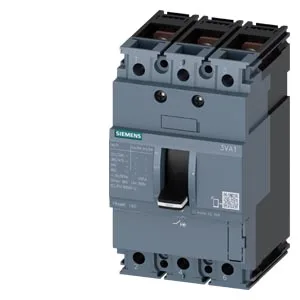
It carries a continuous 63 A at 40 °C (derated to 58 A at 70 °C) across three poles, with a TM210 thermal-magnetic release that handles overload and short-circuit tripping without external control power. Breaking capacity is the headline here: 220 kA at 240 V AC, 154 kA at 415 V, 121 kA at 440 V, and still 17 kA at 690 V. At 690 V the 17 kA still covers most industrial motor-circuit fault levels.
For a site electrical engineer working through a coordination study: the 63 A frame with 220 kA SCCR at 240 V gives you headroom to cascade downstream breakers with lower interrupting ratings, provided the let-through energy (I²t) of this MCCB is below the withstand of the downstream devices. Siemens publishes energy let-through curves for the 3VA1 series — use those, not generic assumptions, for the series-rating tables. The TM210 release is fixed thermal and fixed magnetic — no interchangeable trip units, no electronic adjustment. That simplifies spares but locks you into the 63 A rating. If the load grows, you replace the breaker, not the trip.
The 76.2 mm width occupies three pole positions on a DIN rail. Power dissipation at rated current is 17.3 W maximum — negligible for panel thermal calculations but worth noting if the enclosure is densely packed.