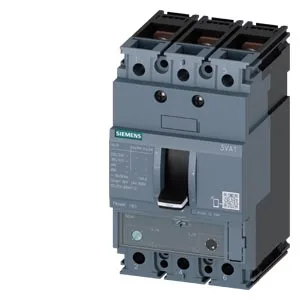
The Siemens SENTRON 3VA1163-6EF32-0HA0 is a 3-pole molded case circuit breaker (MCCB) designed for line protection, rated 63 A continuously at 40 °C and carrying a 220 kA breaking capacity at 240 V. The TM240 thermal-magnetic release handles overloads and short-circuits in one package; the integrated shunt trip (STL) allows remote tripping from a safety circuit or emergency-stop chain. Maximum power loss runs 17.3 W, which is modest for a 63 A frame — panel heat buildup is manageable even in a dense lineup.
The 63 A rating holds flat from 40 °C to 50 °C, then drops 1 A per 5 °C step to 58 A at 70 °C. That matters for a panel builder stuffing breakers side by side in a warm enclosure — you don't lose headroom until the ambient climbs past 50 °C. Dimensions are 130 mm high, 76.2 mm wide, 70 mm deep, which is the standard SENTRON 3VA1 frame footprint. It mounts on a DIN rail or bolts directly to a backplate; the 76.2 mm width (3 inches) means three of these fit in a standard 9-inch (228.6 mm) wide section.
The interrupting rating drops as system voltage rises: 220 kA at 240 V, 154 kA at 415 V, 121 kA at 440 V, and 17 kA at both 500 V and 690 V. The steep drop above 440 V is typical for a 63 A frame — at 690 V the available fault current must stay under 17 kA for this breaker to be applied. That makes it a strong fit for 240 V and 400 V class distribution but unsuitable for high-available-fault 690 V industrial grids without a current-limiting upstream device.